Big picture grid - present tense in Spanish
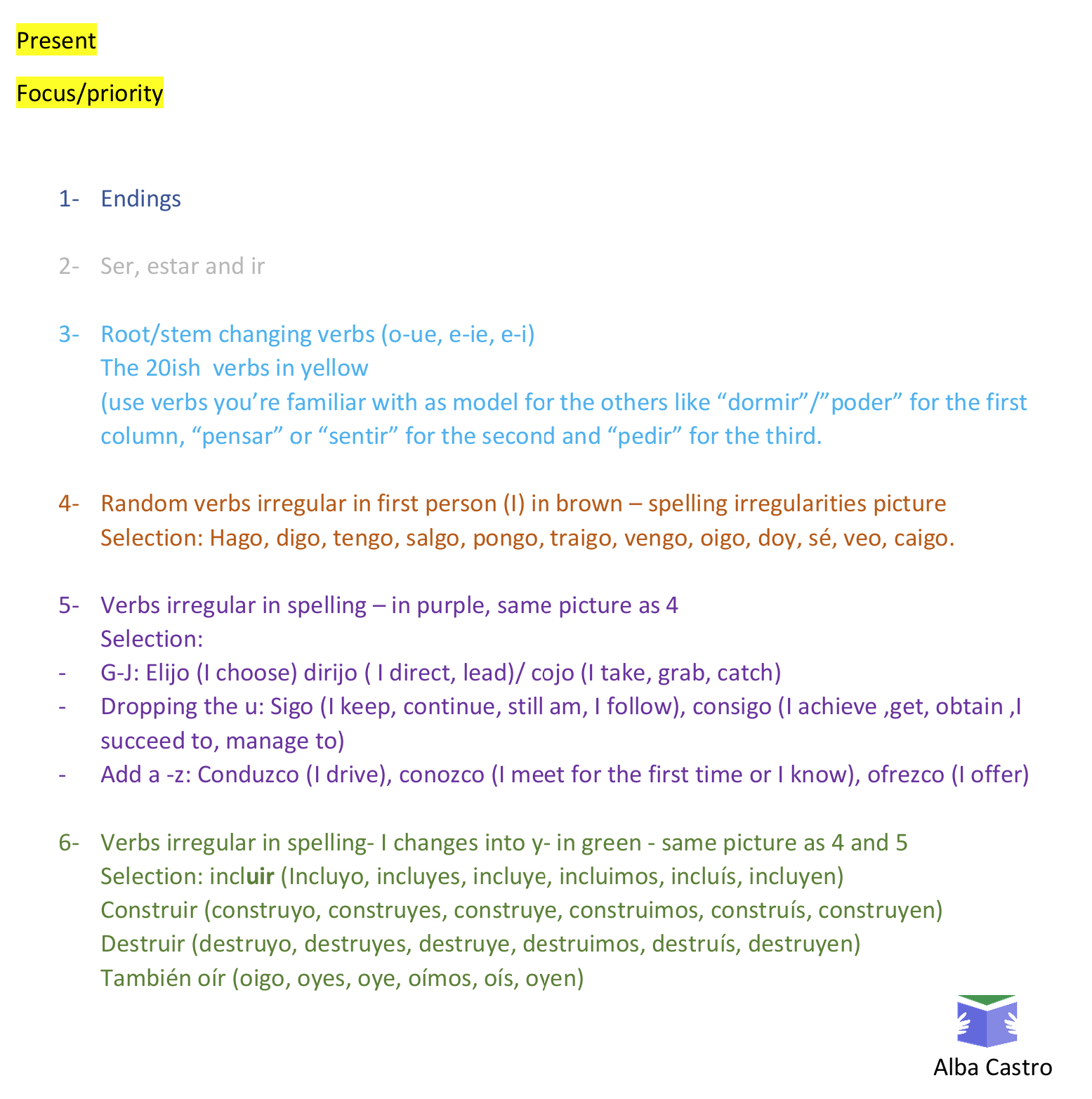
¡Hola! Today I bring to you a different type of grid or table to help us navigate the present tense. This is what it is: A selection of irregular verbs to prioritise. A good point to start, a »
All about the Spanish grammar! I add things here regularly to explain grammar, provide some clarity, encourage to some practice and support you!
¡Hola! Today I bring to you a different type of grid or table to help us navigate the present tense. This is what it is: A selection of irregular verbs to prioritise. A good point to start, a »
First of all, if you prefer this in video form the video on the personal a in Spanish is up now, and at the end of the post. Direct object (person) We use the personal a between the »
¡Hola! Let's start with que and cual, I wrote a blogpost about the differences between que and cual and how to use each of them. Also, this post on the different meanings of que and qué, both with »
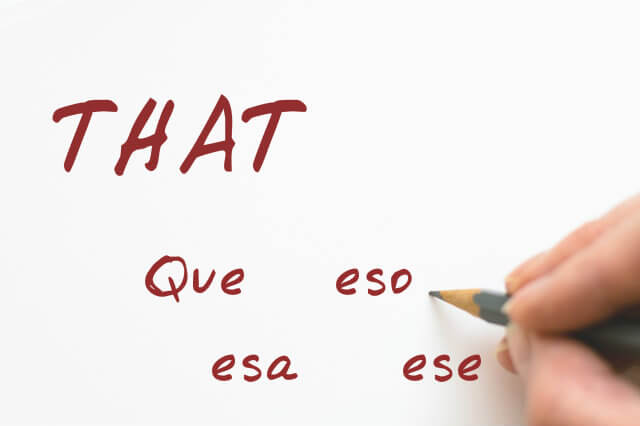
If you want to see the theory in written version check out the blogpost on this and that, which includes practice with solutions. Hope it helped! ¡Hasta la próxima! :) »
Let's see all of the different situations we must use the preposition a in Spanish: Destination When we have a movement action and there's a destination and we use a. These wil happen with all verbs of movement: »
Do I say "le doy a mi hermana" or "doy a mi hermana"? When do I need the "le"? when do I double? is it necessary? Let's see what the official rules are so that you're never lost »
¡Hola! "Comparison is the thief of joy" said someone once! But sometimes it's just an useful tool to use when we speak, right? Let's see how we compare in Spanish! Starting with recaping more and less: More than »
NOUNS Nouns are: things, people, places and abstract ideas. Ex: lámpara, felicidad, gente, amigo, casa, lago, mesa - lamp, happiness, people, friend, house, lake, table. For the most part we can guess the gender of a noun just »
Do you want to understand better what each verbal tense is for in Spanish? Do you want the big picture? Keep reading! Also, in all cases there is a link to another post/video where you can learn »
¡Hola hola! So this is a doubt that has arisen in a lesson recently and I thought it might be a common one for more students out there! QUE (with no accent mark) Type of word: Connective After »
¡HOLA! This, that, those, these... they clarify how close or far away something is from the person speaking. These words are one type of "determiners", words that usually go before the noun, or alone. The noun can be »